
Thanks to the generosity of Jack-fi, I was able to get my hands on a remarkably intriguing device. They were kind enough to lend me this unit for some serious hands-on experimentation.
This device is extremely versatile, functioning as a network streamer, DAC, and pre-amplifier. Additionally, they’ve loaned me the Lumin L1 Music Server, making for an even more comprehensive testing experience.

Features & Specs
You can find all the details here.
Main features
LUMIN P1 makes system integration easier than ever:
- 9 digital & analogue inputs
- USB digital audio input & output support up to Native DSD512
- Balanced & unbalanced analogue inputs
- SPDIF & AES input support up to 192/24 & DoP
- HDMI 2.0 inputs & 4K passthrough with ARC support
Specified for exceptional musical performance:
- New processor delivers native DSD512 & PCM384 playback
- Dual Mono design throughout maximises channel separation
- Dual ES9028PRO SABRE DACs in Mono mode
- Femto Clock System with precision FPGA distribution
- New integrated dual-toroidal linear power supply & all-in-one chassis
- Fibre Network provides complete isolation from network digital noise
- Leedh Processing lossless volume control
9 digital & analogue inputs
New to LUMIN P1, 9 inputs provide enough flexibility for any audio or video stereo system:
USB
- Industry-leading XMOS USB audio controller
- Native DSD512 and PCM384 compatible
- Windows 10 & Mac OS compatibility
ANALOGUE
- Balanced and Unbalanced analogue input
- LEEDH volume processing
- Passthrough function for home cinema integration
SPDIF/AES
- DoP64 / 192 kHz 24-bit compatible
- TOSLINK, SPDIF (RCA), AES inputs
HDMI
- HDMI 2.0 Specification compatible
- Supports 2.0 PCM audio decoding
- HDR, Dolby Vision, Dolby Atmos, DTS passthrough
- ARC compatible output
X1 Heritage
LUMIN P1 takes many flagship features from the outstanding LUMIN X1:
FIBRE NETWORKING
Immensely popular on X1, optical networking provides complete isolation from network noise. Additionally, dual network ports mean that you can connect LUMIN L1 or a NAS directly to P1.
FEMTO CLOCKING SYSTEM
P1 includes dual Femto crystal oscillators and our proprietary FPGA clock distribution system first debuted in X1.
OUTPUT BUFFER DESIGN
The fully balanced Dual Mono analogue output module including legendary Lundahl Output transformers has been keeping music-lovers happy since the original LUMIN A1.
DUAL-TOROIDAL POWER SUPPLY
The roomy P1 chassis provides space to move the X1 toroids inboard for a cleaner installation, while retaining all the benefits of separate analogue and digital circuits.
Flexible setup options
Use as a streamer, a DAC, a pre-amplifier or all three!
IDEA 1 – STREAMING DAC
LUMIN P1 can be used like all other LUMIN players. With its DSD512/PCM384 support, Femto Clock System, Fibre Networking, toroidal power supply, and Leedh Processing, P1 is second only to LUMIN X1 in pure streaming ability.
IDEA 2 – HI-FI HUB
Connect all your stereo sources to LUMIN P1 and attach a power amplifier and you’ve got everything you need for an incredible music system.
IDEA 3 – 2-CHANNEL TV SYSTEM
No need for an AV Receiver. Simply attach your HDMI sources to LUMIN P1 and P1 to your TV. With HDMI ARC, all your audio comes through your main speakers.

Listening impressions and tests
You can also check my shorter video review here:
Let’s kick things off by discussing the setup. I must commend the seamless process, with everything falling into place effortlessly. The mobile app might require a slight learning curve, but once you get the hang of it, it’s pretty intuitive. Upon connecting the unit to the network, it was instantly recognized by the application – no extra fuss required. Even more impressively, when I connected the Lumin L1 Music Server, the application automatically synced with it, allowing me to play music through the P1 immediately.
You can also conveniently link to your preferred streaming platform directly within the app, and use that as your music source. The device offers support for Tidal, Spotify, Qobuz, Plex, and Internet Radio.
Regarding testing, I utilized the following components:
- Benchmark AHB2 Speaker Amplifier with both A90d as pre and the Lumin P1 as pre
- Topping A90 Discrete HP Amp
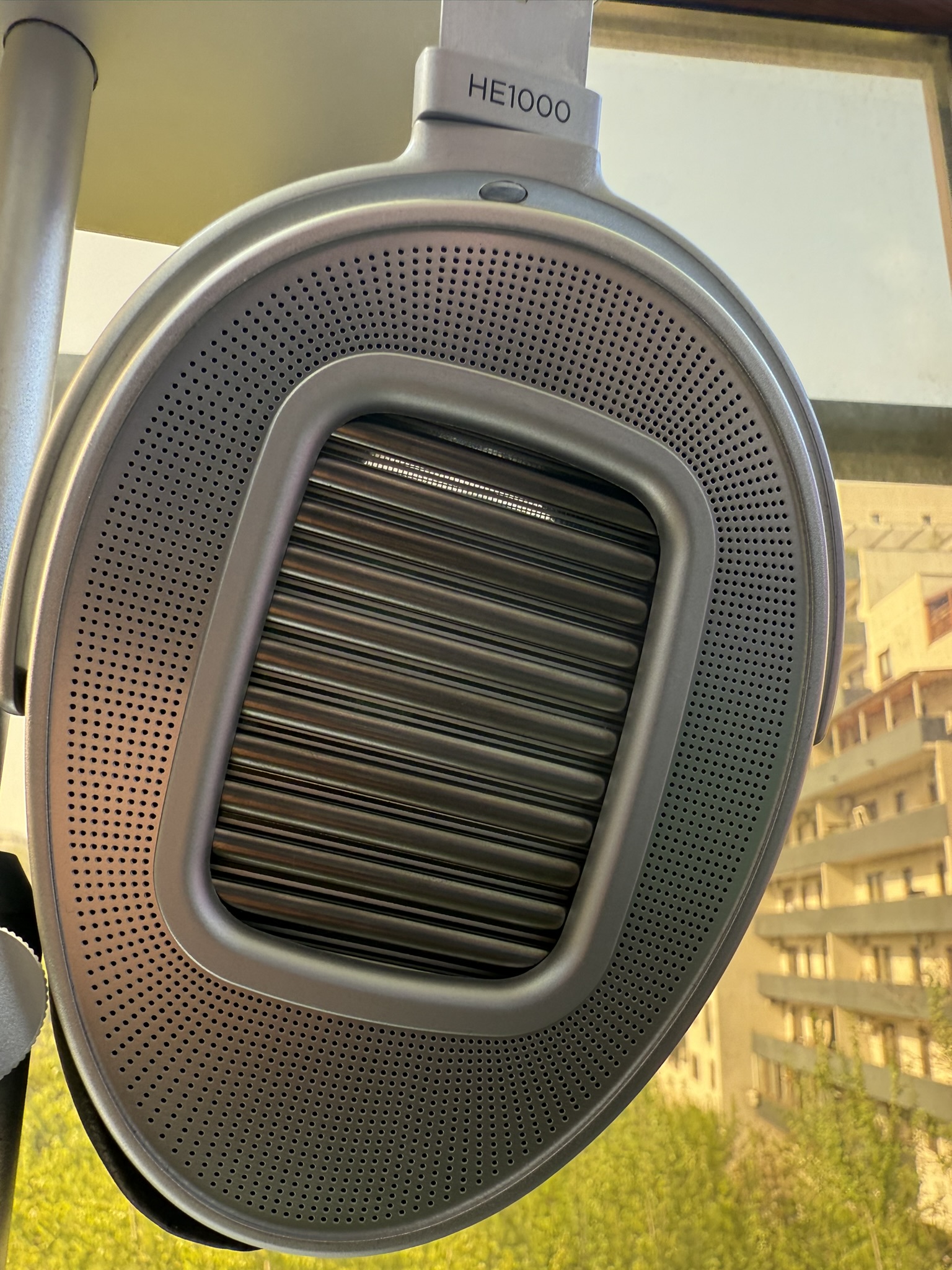
- Hifiman HE1000SE
- Meze Elite
- Meze Liric
- Martin Logan ESL11A
- Denafrips Gaia as usb interface -> xlr aes input in P1 for direct connection with the PC
I tested the DAC output from my PC, utilizing the Denafrips Gaia as an interface from USB to AES into the P1. While the sound was quite satisfactory, to truly unlock the unit’s potential, I found that using it directly as a streamer gave a significant boost to the sound quality. The audio became cleaner, less harsh, with improved details and overall clarity.
As noted earlier, I conducted tests with multiple headphones as well as my cherished Martin Logan ESL11A speakers. The results were impressive in both scenarios, but I must admit, the pairing with the Martin Logan was exceptionally good. The speakers seemed to open up, particularly in the upper midrange/treble area, and the soundstage noticeably expanded in size and depth. The sound is strikingly fast, crisp, and detailed, offering excellent micro dynamics. It was a joy to listen to. That said, the experience with the above-mentioned headphones was equally striking, which attests to the versatility of the Lumin P1.

Stan Getz – I want to be happy
Deciding which instrument to begin with is a challenge, as all were rendered with such striking precision. I’ll start with the saxophone, which was reproduced so cleanly, so expansively, and with such intricate detail that I could feel its sound resonating throughout my entire body. The piano and double bass were equally spectacular. The overall experience was so engaging and emotionally resonant that I found myself standing still, even forgetting to breathe at one point due to the sheer depth of the immersion.

The way the music began immediately induced relaxation, drawing me into the song instantaneously. When the bass kicked in, it was like a powerful heartbeat pulsating through the experience. As the vocal effects resonated, I found myself completely absorbed within the depth of the song, submerged in the experience itself. It felt like a profound connection, as though I had become one with the music.

The electronic guitar vibrated with life infusing energy alongside the drums into the song. The vocals and instruments were also quite holographic and seemed to appear from different and beautifully separated layers of sound. Oh man…when the electric guitar solo started, it was mesmerizing.
Goose bumps again. The guitar plucks gently tickled my ears while the harmonica, vocals, crisp piano surrounded me from all directions.
I have listened to many many other songs, but I will go directly into summarizing the experience as a whole.
Summary
Bass
The bass performance was indeed a surprise. It hits low, fast, and powerfully. The experience is quite delightful. The bass extends impressively, displaying multiple layers of detail. Interestingly, despite its depth, it isn’t heavy – its rapidity imparts a certain nimbleness. The bass seems to emerge out of nowhere, striking hard and low, but also fleetingly, leaving no lingering resonance.

Midrange
The midrange performance was notably detailed, imbued with richness, an abundance of information, and emotion. As someone accustomed to high-end implementations of R2R DACs, describing this experience is a bit challenging. The P1 is a delta sigma based on Dual ESS SABRE32 ES9028Pro DAC chips. Let’s say that in the past I didn’t find compelling implementations of dacs based on Sabre Chips, but Lumin P1 is the perfect example and proof that Sabre Chips can sound amazing if implemented correctly, and that the overall architecture is the most important aspect.
With good implementations of R2R dac chips, the midrange usually attains its magic through extremely detailed textures and a certain proximity to the vocals, instruments, and materials. Here, however, we encounter a different kind of magic.
With the P1, you aren’t as close to the music; it’s as though you’re seated a bit further from the stage, yet the magic persists. The textures are present, the details are bountiful without being intrusive. Everything seems lighter on its feet, yet the sound is rapid, incredibly clean, and engaging. It’s effortless to become enveloped in the music, losing yourself within its depths. I found myself able to focus on individual instruments or vocals and truly sense the detail, vibration, and emotion they were designed to convey. A few times, I must admit, the P1 managed to strike tears of joy from me – a testament to its profound musical impact.

Treble
The treble was surprisingly detailed yet remarkably smooth. It delivers a sense of airiness, a sparkling energy, and even the transient hits in the treble in a manner that’s engaging, detailed, and smooth. Initially, I was almost certain that my HE1000Se would come off a bit bright with the P1, but this was not the case at all. The harmonious balance struck by the Lumin P1 is commendable.

Vocals
With a quality R2R DAC, the vocals tend to feel closer to you. The P1, in contrast, positions them slightly further away, yet in an intriguing twist, the vocals seem to envelop you from all directions. They come across as clean, holographic, immersive, and highly detailed. The vocals are quite mesmerizing, and I found myself being swept away by them, becoming one with the music and losing myself in the experience. This phenomenon is yet another testament to the P1’s unique and captivating sound presentation.
Timing/Detail/Dynamics
I must say that the P1’s performance in this domain is truly impressive. The sound is smooth, but it’s the right kind of smooth – not the dull, monotonous type. This smoothness is achieved by superb timing, pace, absence of digital harshness, incredible speed, and clarity. This performance could very well be the result of an exceptional implementation of the femto clock system. There was no discernible jitter or harshness. The contour, the leading edges of each sound, are really well-defined, and the transition from one musical note to another occurs with such ease, against a backdrop of profound silence.
The device also excels in both macro and micro dynamics. The sound can be explosively engaging, whether you’re seated in the first or last row of the orchestra. The listening experience is truly absorbing and fun.

Transparency & Details
The sound is incredibly clean, with the background as black as it can possibly be. The contrast between sound and silence appears infinite, lending an extra dimension to the auditory experience as it unveils numerous layers of detail. The clarity is akin to watching an OLED display equipped with advanced HDR capabilities – crisp, vibrant, and teeming with depth.

Imaging/Soundstage
The soundstage is genuinely holographic and immersive. Each instrument is distinctly defined in space, creating layer upon layer of holographic depth. The experience is wholly engrossing, making for an auditory spectacle that’s both complex and captivating.


Conclusions
I must confess, the Lumin P1 took me by surprise. In my experience, I’ve never encountered such an exquisite implementation of Sabre technology. Initially, I was somewhat apprehensive about potential brightness or harshness in the sound, but these fears were completely unfounded. The overall sonic performance is simply breathtaking. It’s devoid of any harshness, producing an incredibly clean and detailed sound that doesn’t overwhelm.
Moreover, the timing, engagement, dynamics, and transparency offered by this DAC are so immersive that it’s easy to lose oneself within their music library.
As previously noted, the versatility of the Lumin P1 is another commendable aspect. It can effortlessly adapt to a variety of situations and needs. Remarkably, it was almost a plug-and-play device. Everything fell into place smoothly, with no hassles in setting it up. It simply worked.
The Lumin P1 doesn’t come cheap, but then again, excellence seldom does. It provided me with an extraordinary listening experience, and I cannot recommend it enough. Do try it for yourself; it might be a challenge to let it go once you’ve experienced its magic.




Leave a Reply