A Journey to Audiophile Nirvana: T+A Solitaire P Headphones Review
I have been holding onto this review for a while now. You can find here the first contact I had with these headphones here. I was so impressed with them at the Munchen High End Show, that I have bought them for myself few months after the event. I have delayed this review because my…
I have been holding onto this review for a while now. You can find here the first contact I had with these headphones here. I was so impressed with them at the Munchen High End Show, that I have bought them for myself few months after the event. I have delayed this review because my time was limited in the last few months but also because I wanted to make sure that what I was hearing is consistent. I will make a few bold claims in this review. So, if you are curious, please hang on for more.
As you might already know, I started my journey in this hobby in 2008. I was able to explore this world of audiophile bliss at an exponential rate. I went from “wow, holy s***t, these Sennheiser 595 headphones are the best I’ve ever heard” to listening to speaker systems worth more than $300,000 and incredibly expensive headphone systems in less than ten years. I consider myself both lucky and unlucky from a wallet point of view :)).
I’ve seen most sides of the coin, from a lack of experience to exaggerated points of view where people think a $50k power cable is worth the price. I’m not judging anyone, but I’ve learned this hobby is quite subjective, no matter how much we try to stay objective. I like to think of myself as a fairly objective person, but as I’ve said many times on this website, I’m well aware this hobby is quite subjective. I’ve always encouraged people to try different gear for themselves if they have the chance. As much as I try to be objective, I can’t beat your personal experience with those headphones/amp/dac/etc.
Keep in mind that even our ear canals differ in shape, and that alone can make each person experience the same pair of headphones/speakers/etc. in a different way. I’m not even talking about how people lose part of their hearing performance with age and might rely on secondary harmonics. Nothing wrong with that.
You might wonder why I’m going into so many details in the intro of a “mere” review. This isn’t just another review from my perspective. It’s part of a very special and rare category of reviews on my website—one that’s part of a life-changing experience for me, from an audiophile point of view.
These headphones are something else, and while of course not perfect, they are absolutely magical in how they reproduce music. They give me shivers down my spine (in a good way).
I’m talking about the T+A Solitaire P headphones. I’m really happy I had the chance to listen to them at the Munich High End Audio Show 2024. I’ve been in this hobby for many years, as mentioned above, and I’ve seen a lot of hype around different products—hype that wasn’t always justified by real-world experience. I’m really shocked these headphones have been around for some time now and haven’t received the attention they deserve. At least for my taste and experience, they should have created MUCH more hype than they’ve had so far. I’ve seen many other products achieve incredible hype without this level of quality behind them.
Also, the funny part is that I have found the headphones in the T+A booth, not the headphone section of the show. The T+A booth had many other things and a few headphones in the corner of the show room, that was most likely ignored by headphone enthusiasts. Something like…..T+A saying “yeah…we also make some headphones”. So, imagine my surprise finding one of the best headphones in the world in such a way.
Now, as I mentioned a few times before, I had the opportunity to listen to incredibly expensive and high‐performance speaker systems and headphone systems throughout my journey in the audiophile world. I also had the pleasure of spending adequate time with both the Sennheiser Orpheus 1 and 2.
I’m going to make a bold claim and say my home system is actually more to my liking than those two, and my system includes the T+A Solitaire P headphones. I apologize for delaying this review, especially since I’ve owned the headphones for more than a few months now, but I wanted to confirm my bold claim. I can now say that I absolutely love these headphones, and I don’t need to hold back any longer. Not to mention, when I put these headphones on, I just want to listen to music—not write reviews :)).
I’ll start with a small rant before going into more details about theT+A Solitaire P.
You might think I was being a bit aggressive in my choice of words. Well, I’m frustrated that I had to go to Munich to learn about these headphones for a good time after they were released. I’ve seen so much hype—especially around Hifiman Susvara—with reviewers everywhere, and yet NOTHING about these headphones. I’m not saying the Susvara isn’t good; they’re incredible headphones, but I much prefer the T+A Solitaire P.
Back to my initial thoughts: this is a subjective hobby, but this is the first time I’ve noticed such a big discrepancy between my tastes and the rest of the crowd. That said, considering how hard it is to make the Susvara sing and their recent “open/no grills” development, plus THE PRICE, I’m just not impressed. What’s next? Did you know the headband itself can produce unwanted distortions? So what’s next—removing the headband? :)) Yeah… good job, Hifiman! By all means, experiment, try new stuff, but don’t come out with new models where you remove the parts that make your job harder and then charge your fans/buyers more….
Yup, I’m “ranting,” but I think Hifiman and others who follow the same path deserve the criticism. They did this to themselves. And while I’m at it, Sennheiser is next on my list. They have great products, but they haven’t really released a true new flagship headphone since 2009, when the HD800 was released. Please don’t mention the HD800S. It doesn’t deserve to be called a new flagship; it’s just a modded HD800. Their only real achievement was the new Orpheus, but forgive my wallet if I don’t want to spend over $70,000 on a pair of headphones. They do sound impressive, but as you’ll see in this review, I consider the T+A Solitaire Pheadphones to be in the same ballpark. I have a few others on my list I could continue to rant about, but let’s get to the product at hand.
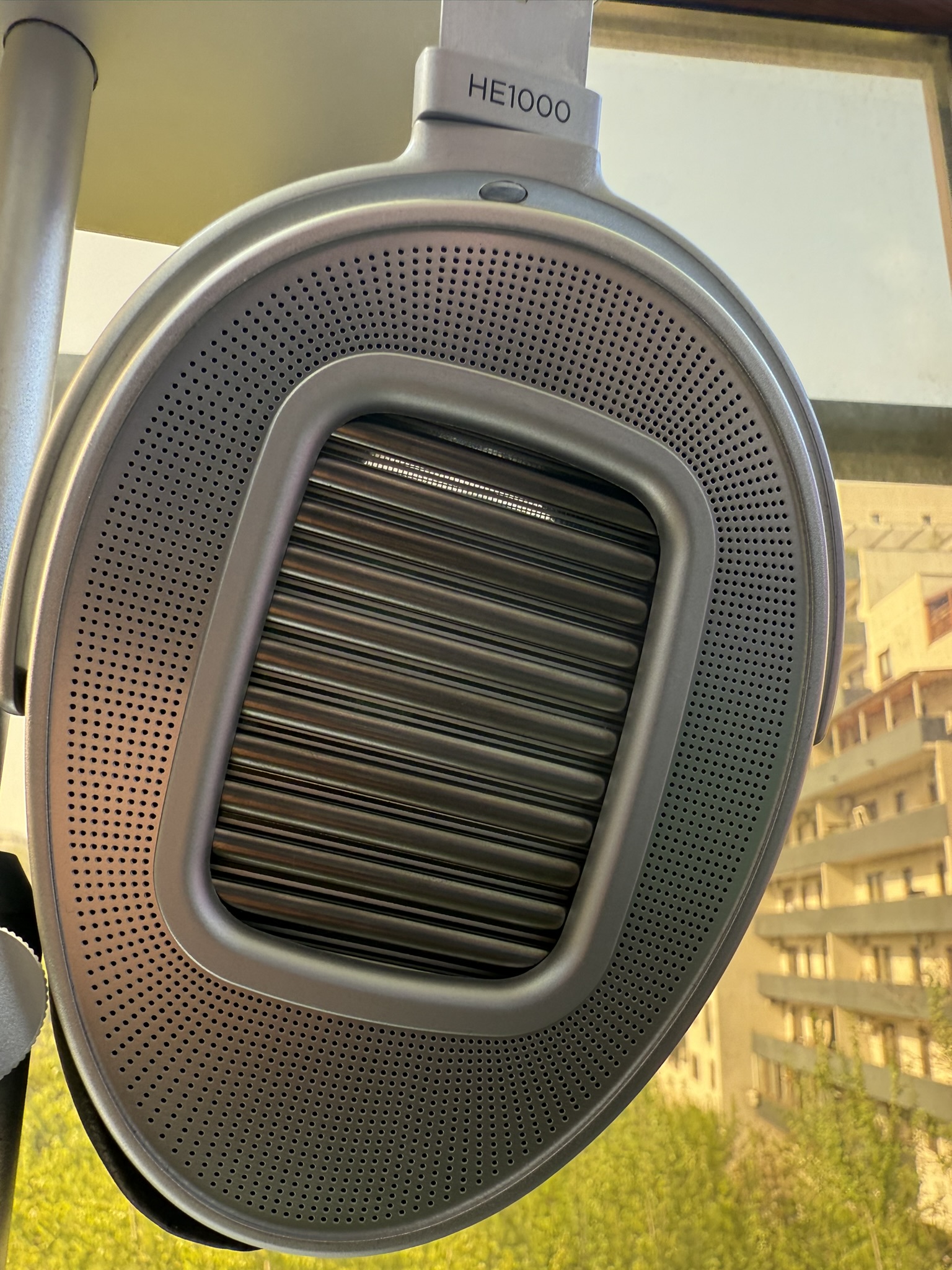
In every transducer – regardless of whether a loudspeaker or headphones – the diaphragm needs to be driven as evenly as possible. To a limited extent dynamic systems based on voice coils are partially successful in this, but planar systems – such as electrostatic or magnetostatic devices – are much more effective in this regard, since the driving force in both these processes is distributed over the whole of the diaphragm, rather than being localised at the coil position. In principle the actual transducer of our magnetostat consists of rod-shaped high-performance neodymium magnets of varying length, with an innovative pole geometry. These magnets are held in a precise, accurately manufactured mount which guarantees the positioning of the magnetic poles to an accuracy of a few hundredths of a millimetre. This design generates a totally linear magnetic field, in which the special ultra-lightweight diaphragm moves. The diaphragm itself is only a few µm thick, and consists of a structurally stable High-Tech polymer material; it also bears an array of very light conductors – also only µm thick – which are applied in a sophisticated, highly precise photo-chemical process. This unique technology ensures that the entire surface of the diaphragm is driven absolutely evenly, thereby eliminating the partial oscillations which are unavoidable with localised drive systems. The net result is a series of transducers with an enormously wide dynamic range, high peak sound pressures and extremely impressive linearity and freedom from distortion. Our Solitaire P and Solitaire P-SE headphones are driven by our in house transducers TPM 3100 and TPM 2500, respectively. Both of which are manufactured in Herford, Germany.
Let’s talk a bit about the design, materials, and comfort level. First of all, the headphones look quite well-built with quality materials. They feel like a sturdy pair of headphones. Also, I love the grills. Why am I mentioning them? I’m thinking of Hifiman and their new “innovation” of removing the grills. Well…the grill on the T+A Solitaire P seems to do an amazing job, since it doesn’t seem to influence the sound much, not even when you put your hands over it. Eh…Hifiman…it’s possible…and apparently others have done it, too.
The stock cable, for once, does a pretty decent job. I actually used it with the Sennheiser HD800S, and it was considerably better than the stock cable the HD800S came with.
When it comes to comfort, they can be really comfortable, but for the first few months I had some issues. The headband took a while to “break in.” What am I talking about? Well, the headband cushion was a bit too hard at first, and the headband itself was a bit too narrow for that material, so it applied too much pressure. After about an hour, it started to hurt, and after a week, I checked under my hair because I started to feel like this. I’m exaggerating a bit, but it really was uncomfortable.
I think T+A could have avoided this with a better material for the headband cushion or by making the headband a bit wider.
The good news is that after a few months, the cushioning got softer and the problem almost disappeared, but those first two months were a bit frustrating from this perspective.
Listening Impressions and Tests
Before getting into more details, let’s give a few details of the system that stole my heart. My setup was: PC-> Matrix Element H powered by the Keces P8 linear power supply -> Audioquest Diamond USB -> Denafrips Gaia -> (i2s Audioquest Diamond) -> Rockna Wavelight (with balanced XLR 5.8v output, using Audioquest Sky XLR) -> Holo Bliss KTE- > stock T+A Cable -> T+A Solitaire P Headphones. Edit: I did use the headphones with the Rockna Wavelight for a few months and since the beginning of December I have been using them with the new Rockna Wavedream Reference Signature. Rockna didn’t publish the product details, but it is their statement DAC which is even better than the Rockna Wavedream Signature that was reviewed here. I wasn’t very sure how this would be possible, but apparently it was quite possible. A review for Wavedream Reference Signature is coming soon.
Meanwhile, what I wanted to point out is that the T+A Solitaire P scaled amazingly with the new marvel of a DAC, so both T+A Solitaire P showed the capabilities of the wonderful DAC and the Wavedream Reference showed the amazing scaling capabilities of the Solitaire P.
I would also mention that the Holo Bliss KTE seems to be an excellent choice for these headphones. They are not as power hungry as Susvara, but you do need good power and a capable / transparent amplifier to unleash the capabilities of these headphones.
I have many things to say about the sound, but let’s go through a few songs.
Handel: Suite in A Major HWV 426: I, Prelude
The harpsichord sounds absolutely stunning—the crispness, precision, clarity, and transparency are just amazing, a pleasure to behold. It’s so detailed, so full of life, so crystalline that it’s hard to describe in mere words. It feels like being right next to the instrument, almost like living inside it. Superbly reproduced. What I loved most was the level of transparency, speed, and natural tonality it delivered. I felt like it was an electrostatic experience, but with the weight and naturalness of a dynamic driver.
Vance Joy – Riptide
Oh man, the way the instruments blend together in perfect harmony with the voice—while keeping a very dynamic and energetic listening experience for this type of song—is just mesmerizing in my opinion. It’s so natural, so euphonic, and so dynamic that it made me close my eyes and focus entirely on the music.
Laura Fygi – Histora de un Amor
The voice is expansive—it’s like it’s hugging you from all directions, as if the artist is singing sensually right in your ears. The guitars add to this incredible experience with a tactile, crystalline, and sparkling quality.
Carmen – Marcin
This is almost a surreal experience. The level of tactility, detail, energy, and precision on these chords is something else. First, you get the addictive, full, and captivating bass experience, but then you get the incredibly precise leading edges of each note—the sparkle of each chord, the deep vibration, the nuance, the detail. It’s so musical, so engaging, so fun, and so impressive that it leaves me floored even after listening to this song for the 100th time.
Antoine Dufour – Talk
Oh man, the chords are just magical. It’s a similar experience to what I described above, but because it’s focused on guitar strings, it’s much more apparent. Each note is incredibly crystalline, pristine, and full of life, vibration, and precision. It’s a mesmerizing experience.
Janis Ian – Breaking Silence
The voice is so sweet and intertwines so well with the electric guitars and tactile drums that it just hits the right audiophile sweet spot. Then the guitar strings come into the song in a crisp, tactile, and detailed manner. Lovely experience.
Witcher 3 – Blood and Wine official soundtrack
I love that game, and the soundtrack is amazing as well. With the T+A headphones, the soundstage, immersiveness, realism, and engagement were stunning. You can hear the instruments hitting your eardrums, vibrating with life and energy, and the vocals transcending space and time. It’s like the song draws you right into the Witcher universe. By the end, I felt like I was the Witcher.
Abba – Take a chance on me
The chorus at the beginning is incredibly personal, with amazing texture and realism. It’s like they’re singing right in your ears; you can feel their breath, and the level of realism is stunning. I got goosebumps multiple times during this song. The drums are punchy and incredibly fun.
Moonhearts in Space (Dies Irae Tina Guoe)
The cello struck me from the first seconds. It sounds subtle, detailed, alive, and holographic. When the voice came in and instruments like the electric guitar and additional cellos started to appear, it felt like the scene separated into a large number of layers, lifting me into a vast soundstage and carrying me from layer to layer, from instrument to instrument, and from voice to voice in an emotional rollercoaster.
For those about to rave, Timmy Trumpet, Scooter
Let’s try a really bad recording, because that’s what this is. It’s bad, but…what the hell…it’s fun. Oh yeah! The voice starts off sounding big in a huge soundstage, and when the drums and the fun kick in, the song becomes really entertaining and engaging. The bass hits hard, the soundstage is HUGE, and fortunately, we don’t get any harshness that would destroy our ears like it usually does on this track. It was a very engaging and fun experience. Hell yeah!
Lover, Lover, Lover – Candleland & Mysterio – Ian McCulloch
The song starts in a delicious way. The rhythm and dynamics provided by the drums and guitars are instantly appealing, thanks to the very strong impact of the drums and the tickly, sparkly guitar plucks. The attack and decay on these headphones can sound magical, showing how fast and accurate they can be, while also having a perfect balance and detail in the decay. This balance infuses the music with a natural, real-life sound and a sense of technical musicality.
Greatest Film Classics – Jack Sparrow – The Royal Philharmonic Orchestra
The song starts off quietly but with strength, showing the Solitaire P’s excellent microdynamics. The cello begins with a vibrating, natural texture, which gradually grows in energy and life. The sound soon becomes a feast for the ears, with instruments resonating all around you in a very detailed, engaging, and holographic manner.
40 Days – The Wailin’ Jennys – Arlington
Oh man, the voice hits with so much texture and natural timbre that it reaches your soul directly. The acoustic bass hits strong and incredibly deep, while the viola vibrated my soul with incredible texture, detail, and liveliness. Meanwhile, the acoustic guitar tickled my ears with amazing tactile transients.
Copland: Super Hits – Fanfare for the common man
The display of increased dynamic range in this piece is mesmerizing as it gradually grows in intensity. Even when it starts from a lower dynamic range, the instruments still show liveliness, natural textures, and good dynamics, and it becomes a feast for the ears once the song gets louder. The stage was also a very important factor here. It starts from a HUGE soundstage that feels far, far away, and you get closer to it as the piece goes on. The soundstage is so deep and holographic that it feels like I’m hovering in space from the edge of the solar system, moving closer and closer to the sun. The sun is already bright and full of life from afar, but it becomes even brighter, more vibrant, and more exciting as I approach it.
Earth Melodies – Ekaterina Shelehova
If you haven’t read some of my previous reviews, on the right gear, this song and voice shocked me. It’s a very interesting test piece because it tends to sound shouty on systems that aren’t well balanced, but when you get your system right, this song is amazing. I can confirm that was the case with the Solitaire P. As expected, these headphones and this song helped me transcend the space-time continuum, see the galaxy from above, go back in time, move further into the future, and become one with the universe.
Brushed – Markusphilippe Plus Bischi – Sensuelle
The saxophone in this song was stunning. It was incredibly detailed, textured, and natural, and I could actually feel the breath in my ears. It was so intimate that it gave me goosebumps. The double bass and drums were deep, with incredible detail in the extension of the decay. Ointment for the soul.
Summary
Bass
The bass is superb—one of the best I’ve ever heard, if not the best. It’s incredibly fun because it hits like a truck, yet it’s also very detailed and fast. I’m not sure how to explain this, but for example, in the Gojira Drum Solo, when the drum hits, you don’t just hear the drum—you feel the drum. You become one with the drum. You understand and feel the material the drum is made of as you vibrate along with it.
Midrange
The midrange is magical. It’s full of detail, textures, and a very lifelike, natural character on the right system. It vibrates with life; the vocals are incredibly present, transparent, and intimate when they need to be. Instruments sound real, and vocals feel like they’re in the room with you. The lower midrange is a bit more present, and the upper midrange is as well. Compared to some other headphones like the ZMF Caldera, it has a bit of a dip in the 1-3khz region, but I didn’t feel I lost anything. It preserved the detail, texture, liveliness and textures, even if it was a bit more laid back. It actually helped with the sense of space/holography.
Treble
I’d say the headphones’ sound signature is a bit darker overall. Don’t get me wrong, they are not dar as in the first Audeze models, they are darker compared to the likes of Hifimans. The treble is there but not in your face—it’s detailed and natural. I actually prefer this to the treble on certain Hifiman models, which sometimes got a bit too hot. In the measurements I have seen a dip before 9khz and a spike around that area, but I didn’t feel anything uncomfortable in the listening sessions. It might very well be an artifact produced by mini dsp ears. The treble is quite good, but not spectacular as the rest of the features of these headphones. I kept comparing them to electrostats from the speed and transparency perspective. Electrostats also have consistent, detailed and tactile treble. While T+A presents good detail and enough presence so it doesn’t sound as a dark headphone, it doesn’t have that tactility in the treble that is present in good electrostatic headphones. Now this being said, the treble integrates very well with the rest and I would not risk changing anything here, as these headphones already sound amazing. I don’t want this balance to be broken.
Transparency
These headphones are incredibly transparent. They resemble electrostatics in that regard, and this was one of the first things I noticed when I tried them, even at the Munich High End Audio Show. They seem to disappear on your head, and sometimes it feels like you’re listening to speakers instead of headphones.
Details
The T+A Solitaire P is capable of a monstrous amount of detail. The good part is that nothing is thrown at you in an unnatural way; everything just sounds right. It’s only when you switch to other high-end headphones that you realize how much detail these deliver. They offer it in such a natural, transparent manner that I tended to take it for granted.
Soundstage/Imaging
The soundstage is stunning. It’s big, it envelops you from all directions, and it’s holographic and very precise about each instrument or sound in the scene. You get layers upon layers, precisely separated in space. I think they have the best soundstage I’ve heard in headphones, including the HD800, even if the latter had a slightly bigger one. It’s not only about size here, but also about the realism it brings to the listening experience.
Dynamics
The transients are amazing, with an incredible explosion in the attack—fast, but very natural in decay. The dynamics are stunning both macro and micro. You’ll have explosive drums in the front layer hitting you with force and precision, and guitars or other instruments in the back of the scene will still vibrate with life and energy.
Realism
This is where it all comes together. On the right system, these headphones can reach a stunning level of realistic, life-like sound reproduction. They also show great scalability. When I added the new Rockna Wavedream Reference (a technological marvel of a DAC), the T+A Solitaire P scaled right up to what I was looking for in my audio nirvana. Everything—transparency, details, dynamics, soundstage—blends together, creating a life-like sonic experience.
Every chord that’s struck, every vocal, every drum hit comes through with such texture and natural tonality that I felt like multiple windows had been removed between me and the music. The digital veil, the system—everything disappeared completely, and I was transported into a marvelous musical universe.
Measurements
As you might know from my previous reviews, I am using the MiniDSP EARS for measuring headphones. This is not a professional unit, so the measurements might not be the most accurate measurements, but I have found it very close to the truth so far and helpful, so here we are.
First, it’s important to recognize that all headphone measurements on a miniDSP EARS rig (or any rig) come with some caveats; the specific coupler, fit, seal, and calibration can all shift the measured response. That being said, here is a general interpretation of what you’re seeing in the graph for the T+A Solitaire P (using HEQ calibration on the miniDSP EARS).
Overall THD is extremely low. As you can see, the distortion measurement is really impressive and barely measurable between 100hz and 3 khz.
A spectrogram (in REW or similar) essentially shows you when and where energy decays across the frequency spectrum. The horizontal axis is time (in milliseconds), the vertical axis is frequency (from bass at the bottom to treble at the top), and the colors represent how loud (in dB) each frequency is at each moment.
Here’s what stands out in your T+A Solitaire P spectrogram:
Overall Decay is Fast and Even
Most of the energy (the bright “bands” in yellow/green) drops off fairly quickly over the first ~100 ms. That suggests there aren’t major resonances ringing on for a long time—indicative of good driver damping and a controlled enclosure.
Bass Region (roughly 20–200 Hz)
You see a thick band of energy near the bottom, which decays steadily over the first 100–200 ms. This is pretty normal for planar headphones. There may be small dips/peaks around 40–60 Hz, but nothing of importance.
Midrange (200 Hz–2 kHz) Appears Smooth
The “middle band” in the spectrogram is relatively uniform, with no big hotspots or “columns” of lingering color. This usually correlates with a clean, resonance-free midrange.
Treble Region Has a Few Quick “Flares”
Around 8–10 kHz (where you see brighter reds/oranges), there’s a bit more energy that stands out briefly in time. Many headphones—especially planars—will show little resonance lumps or dips in the upper registers. The important question is whether they persist (long “tails” in the spectrogram) or die off quickly. Here, it looks like the bursts are fairly short-lived, so not a big cause for concern.
No Major Long-Ringing Hotspots
If you had a severe resonance, you’d see a narrow band of color extending far out in time (several hundred ms). That doesn’t seem to appear here. Most areas fall off nicely within a short window.
How it could be interpreted:
Clean, Fast Transients: The lack of long “tails” across most of the spectrum indicates the driver and housing don’t hold onto energy for too long. That usually translates into a crisp, resolving sound.
Slight Upper Treble Ripple: The brief bright spots around 8–10 kHz show where the headphone’s response is a bit more excited. Because they decay quickly, you might hear a hint of sparkle or brightness there, but it’s unlikely to be a glaring resonance. Personally, I wasn’t bothered at all by the dip/spike in that area. It might just be an artifact produced by minidsp ears.
Good Low-Frequency Control: In planars, well-controlled bass decay typically corresponds to good “tightness” in the low end. The spectrogram suggests that the Solitaire P maintains relatively quick bass response.
Overall, the spectrogram supports the notion that the Solitaire P is a well-damped planar headphone with a mostly smooth response and no obvious problematic resonances. Any small hot spots in the treble likely correspond more to normal planar artifacts than to major sonic flaws.
Meze Elite remains one of my favorite headphones, but I ended up preferring the T+A. The Solitaire P (from the graph alone) might come across as slightly more neutral or technical, with less emphasized mid‐bass, while the Meze Elite can sound warmer and lusher in the midrange, with slightly less spiky treble. In real life, I wasn’t bothered at all by that spike or dip on the T+A—it could very well be an artifact of the EARS measurement.
Both are high‐end planar headphones, but they take subtly different voicing approaches—Meze aiming for a more relaxed, rich presentation, and T+A aiming for a slightly more direct or “studio‐neutral” feel.
I’d also add that the Solitaire P sounds noticeably more detailed and faster across the frequency range. The bass is quicker and presents more detail, and any pluck or transient in general hits a bit harder while having a faster yet more detailed, natural decay.
The soundstage is also larger and more holographic on the T+A Solitaire P, offering one of the most life‐like sounds I’ve ever experienced with headphones.
ZMF Caldera and Atrium for that matter, have both got in the top of my headphone preference list.
While the ZMF Caldera still sounds engaging, with a very fun bass that hits hard and has a weighty body, the T+A has a faster, more layered, and more detailed bass that also hits with huge force. The ZMF Caldera has a bit more presence in the midrange between 1–3 kHz, but I didn’t feel like I was missing anything with the Solitaire P. I still got amazing texture and detail in the mids, even if they were a bit more laid-back by comparison. It actually contributed to an effect that helps the soundstage feel deeper and more holographic.
While the ZMF Caldera has a very fun, natural, and engaging sound, the Solitaire P plays in a different league, offering considerably more detail in a natural way, without forcing anything on you. The dynamics and microdynamics, precision, transparency, soundstage, and even tonality are also better on the Solitaire P.
This is a very interesting comparison. As you can see above, the Atrium also has a stronger presence between 1–2 kHz, bringing a bit more prominence to the mids in that range. I’d say it’s a similar situation to what I described with the Caldera.
When it comes to technicalities, the Solitaire P wins across the spectrum: punchier, more controlled, and deeper bass; considerably more detail; a more layered and precise soundstage (and sound in general); more controlled and explosive transients; and better dynamics, etc.
However, if you’ve read my review of the Atrium, you know I love it for its very musical, fun, and natural sound signature. And yes, while the Solitaire P wins in all categories from a technical perspective, the Atrium still sounds incredibly musical, natural, and engaging—sufficiently different so that I actually enjoy them as complementary headphones.
It’s funny, but I think the Atrium is, for the moment, the only headphone that managed to hold a candle to the Solitaire P. It’s also funny to say that the Solitaire P is the only headphone (or one of the very few) that can hold a candle to the Atrium in terms of a natural, life-like sound experience. That being said, I think I could easily live with Solitaire P as my only headphones if needed.
Compared to Hifiman Susvara
I didn’t have the Susvara at home this time, but I’ve had them here for weeks in the past, and I also managed to listen to them side by side on my good friend Sandu’s (Soundnews.net) very high‐end system. Susvara is still an incredibly good headphone, but I’ve always felt it was a bit overpriced. Why? Because even on top systems, it sounded a bit harsh or too neutral and didn’t capture the emotion of the sound the way I’d like. When it came to pure precision, I felt the HE‐1000SE was faster and more precise, able to stop on a dime more effortlessly than Susvara.
Come to think of it, I believe the HE‐1000SE is also a bit more precise than the Solitaire P at that “stop on a dime” capability, but it loses in most other departments compared to the Solitaire P. However, if I were to have two headphones, I’d pick the HE‐1000SE as a secondary pair to the Solitaire P. I don’t think it’s necessary, though.
You might say I didn’t listen on proper amps/DACs. Believe me, I did—including monoblocks. Maybe it’s just me, and I’m not a big fan of the Susvara’s sound signature, since I ended up preferring the Meze Elite. I found the Elite more enjoyable, while still offering good technicalities (even if it’s not on par with Susvara).
Anyway, I was listening to both the Solitaire P and the Susvara on Sandu’s amazing system (Rockna Wavedream Signature + Cayin U‐170 Headphone Amplifier). On the Gojira Drum Solo track, everything was good until the cymbal came in on the Susvara—I immediately wanted to switch back to the Solitaire P.
The Solitaire P also wins in the bass department: it goes lower, hits harder, and offers more detail, along with a significantly better soundstage and holography. The midrange has more texture, and overall, I’d say it’s in the same ballpark as the Susvara in terms of detail. In fact, because of its bigger soundstage with multiple layers, sometimes the details are even easier to notice than on the Susvara.
Susvara wins in the treble department by presenting more sparkle, more detail, and better consistency in that region. However, it can also sound a bit harsh in comparison. If you enjoy that sort of sound signature and don’t mind the harshness, that might be important to you.
Additionally, the vocals on the Solitaire P are more natural, with better texture and a lifelike tonality, and the overall sound feels more realistic—closer to an actual live experience.
The Solitaire P is amazing in terms of transparency and speed, resembling electrostatic headphones in that regard, but with the added benefit of incredible bass performance and dynamics.
Conclusion
I’ve reached my dream, or “audio nirvana,” in both the headphone and speaker systems. In Europe, the T+A Solitaire P is not cheap by any means, but it doesn’t break the bank compared to other options—especially for the sound you get. These are legendary headphones, and from my perspective, they’re the best in the world at the moment.
I’m not sure why there hasn’t been more hype around them. Maybe T+A didn’t invest in marketing and just let the product speak for itself. Maybe I achieved an amazing system match. What I can tell you is that I’m really happy I discovered them at the Munich High End Audio Show.
It’s remarkable how T+A managed to achieve a level of transparency and speed similar to electrostatic headphones, yet retain the added benefit of incredible macro dynamics, legendary bass, and a life-like sound.
Of course, while they sound natural, they do have their own signature, and it might be a matter of taste. However, I’m telling you—if you like this kind of sound signature, you’re in for an amazing treat. From my perspective, these are the best headphones in the world, or at least among the very best that have ever existed.
I have to emphasize that these headphones will need an very capable system (both dac and amplifier) to unlock their full capabilities. If you do, you will get one of the best possible sound in the world at the moment.
If you have the chance to hear them—do it. They may surprise you the way they surprised me!
Thank you Dan for your detailed and straight forward review, I specially appreciate the list of the testing tracks you used, very very helpful !!
I own the Solitaire P, purchased it based only on Sandu’s great review and compliments, without audition, the first time in my long audiophile life.
I think I have a good, allover, “system”, headphones only.
I would like to add a few personal comments.
– I agree with your definition of the sound being “darker” than the other “big names”.
– I ordered and I use a high quality 100% silver cable which sounds better, brighter, to my taste than the stock cables. (Lavricables)
– It sound basic but break-in time was a key factor to get from the headphones its best. Minimum of 200 hours.
– There is some confusion with the different models that I wanted to point out. There is Solitaire P (the one reviewed) and there is Solitaire P-SE and there is Solitaire T. I think that T+A should clarify the confusion on their website.
I learn how to enjoy its sound, I did not fall in love immediately..
About Lavricables, I have 3 cables, Hifiman 6.3, RCA between the DAC and the Amp and the solitaire P. I am very much satisfied with the results and with the quick and professional response of the owner.
Dear Dan, keep up your reviews and enjoy the music.
Hi, I thought maybe this information will be of interest to you or any other watcher or hobby colleague.
I decided to sell my new Solitaire P and the Lavricables silver extra cable. It is a long and personal story and I will not get into it.
I published yesterday in Audiogon and in the German Audiomarkt. I will sell them with significant discount and pay the DHL or Fedex shipping.
If you one of your or Sandu’s colleagues are interested please contact me directly.
I will be opened to discuss the price.
Thank you, Amnon.
After the review I’d be interested in buying a unit, but the starting price has not been mentioned in the review I think 🙁
So I have done my research. The price at official retailers is 5200€…
I’d like to have a review of the Solitaire P-SE that seems close to the Solitaire P that is reveiwed for a more “decent” 3200€…
So Ammon, even if you’d offer a 50% discount on the Solitaire P, it would still be out of range for me 🙁
It would be within reach with at least 75% discount 🙂
To Dan : yes, the HD800 is now a 15 years old headphone. But I think 3 things should be mentioned :
1°) it’s price, brand new, is now 1400€ which means you can buy four HD800s for the price of one T+A ;
2°) even after a decade it is still among the best headphones money can buy (think about soundstage and detail…) ;
3°) that longevity added to the number of units sold and added to the brand’s name has a pro : you can find replacements and mods super easily…
Also a question : except when you are a reviewer, do we need to change headphones every 5 or 10 years ? I have a pair of Pioneer SE-505. They are about 50 years old. Leather is as new after that ime (and yes it is original). Were it not for their weight (almost 700 grams) they would still be the one’s I’d listen to even ig they are older than me 🙂




Leave a Reply