
I’m truly thrilled because we finally have an excellent distributor for Stax in Romania – Avstore.ro. Not only is Avstore.ro one of the top high-end audio stores, but it’s also the premier destination for headphones in the country. Boasting the best headphone showroom, Avstore.ro officially took over the dealership for Stax at the beginning of June.
This also signifies that I can now thoroughly audition headphones in their showroom, and even have the opportunity to take them home for comprehensive testing. So, here we are!
Today, we’re taking a deep dive into the universe of Stax, a brand that’s held in high esteem by audiophiles across the globe for its exemplary range of headphones. Established in 1938 in Japan, Stax’s history intertwines with the evolution of audio equipment, and the company continues to shape the industry today.
Stax is renowned for its electrostatic headphones, a technology that stands out from conventional dynamic or planar magnetic drivers. Electrostatic headphones, like those from Stax, employ an electrically charged diaphragm positioned between two conductive plates. When an audio signal is applied, the diaphragm oscillates, producing sound waves. This process delivers unparalleled clarity, precision, and transparency, offering a transformative listening experience.
In the spotlight today is the Stax L300, a modern reinterpretation of their iconic Lambda series. The original Lambda series, launched in 1986, set a new standard in the electrostatic headphone arena. Thirty years later, in 2016, Stax introduced the L300, paying homage to its historic Lambda series while incorporating advancements in audio technology. The L300 provides an excellent balance between affordability and performance, inviting a broader audience to delve into the extraordinary world of electrostatic audio.
In this review, we’ll take an in-depth look at the Stax L300, focusing on its design, sound quality, and overall performance. Stay tuned as we explore the sonic capabilities of this impressive pair of headphones and embark on the unique musical journey it provides.
Technical Specs, Design, Build Quality
Main Features & Specifications
- Design: Push-Pull electrostatic oval sound element, Open-Air type enclosure
- Frequency Response: 7 – 41,000Hz
- Electrostatic Capacitance: 110pF
- Sensitivity: 101dB/ 100V r.m.s 1 kHz
- Maximum Sound Pressure: 118dB/ 400Hz
- Bias Voltage: 580V DC
- Ear Pads: High Quality Synthetic Leather
- Cable: OFC parallel 6-strand, low-capacity wide cable, 2.5m full length
- Weight: 323g without cable / 448g with cable
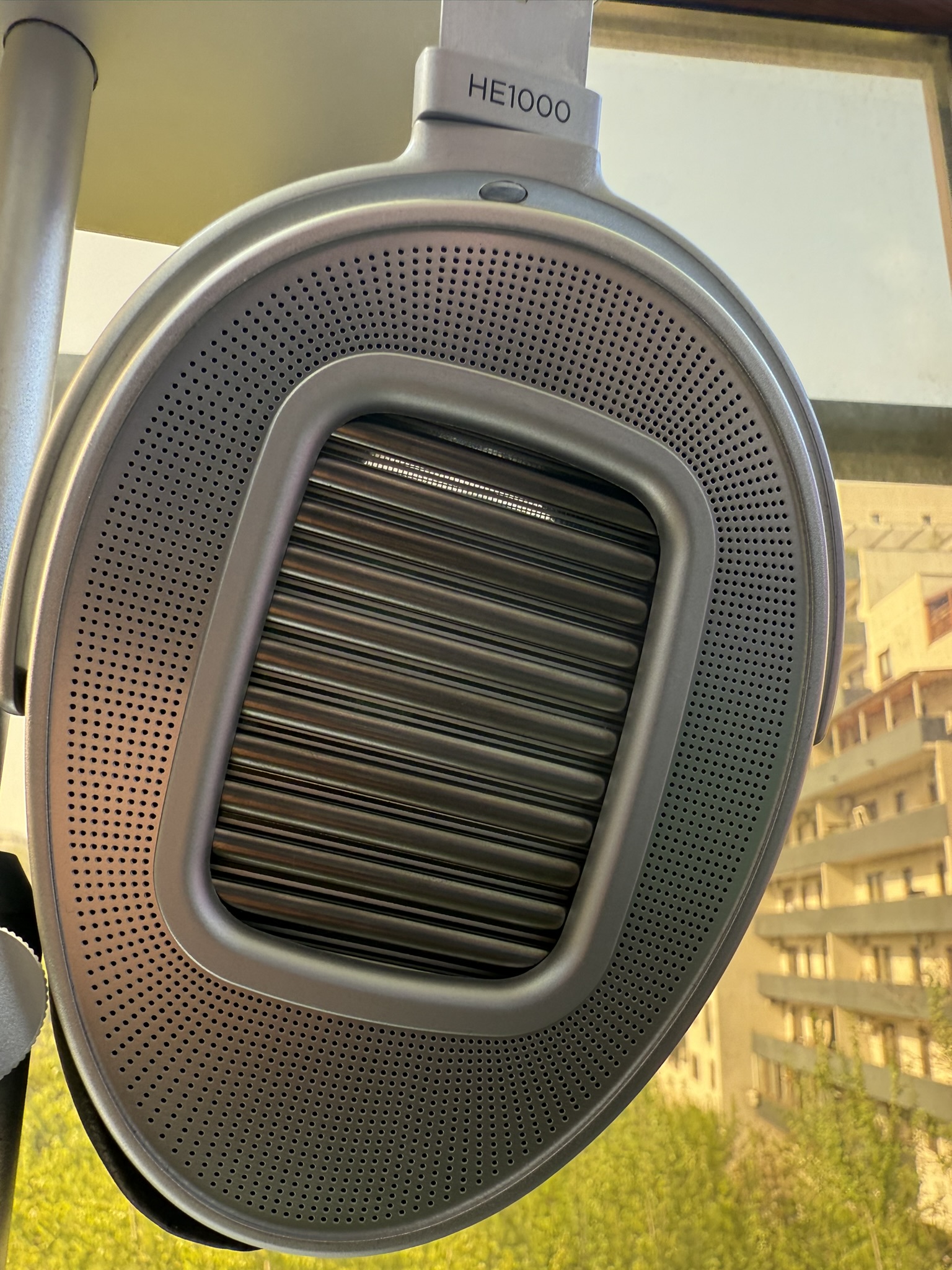
The first thing I noticed was the surprising lightness of the box; it was so airy that I feared it might be empty. To my relief, the headphones were indeed inside, and they felt remarkably light, especially in contrast to what I’m accustomed to. Upon first glance, you might be underwhelmed by their appearance. The design is decidedly retro and somewhat plastic in nature. However, the earpads are pleasantly plush and comfortable.
When you examine the drivers, you realize the main goal of these headphones is to deliver a high-quality driver within an affordably priced headset. Aesthetically, they may not appeal to everyone, but I find the retro design intriguing. One point I can assert unequivocally is their comfort – they’re so light that you can easily forget they’re perched on your head. Despite the cable being non-detachable, it appears to be robust and well-constructed.

While their aesthetic may be a retro nod with their black finish, they certainly deliver an experience that’s brimming with vibrancy and emotion.
You can find the video review here:
Listening impressions and tests
Stax headphones, like all electrostatic headphones, require specialized amplifiers due to the unique way they produce sound. Unlike conventional headphones, electrostatic models use an electrically charged diaphragm placed between two stators. When an audio signal is applied, the diaphragm moves and creates sound waves. However, for this to occur, the audio signal needs to be at a high voltage, typically hundreds of volts. Standard headphone amplifiers cannot provide this level of voltage, hence the need for specialized electrostatic headphone amplifiers, also known as ‘energizers’. These energizers not only amplify the audio signal but also step up the voltage to the necessary levels for the electrostatic mechanism to work. As such, Stax headphones like the L300 can’t be driven effectively by standard amplifiers, necessitating the use of specialized Stax amplifiers or compatible alternatives.
For the purpose of the review, I have used the SRM-400S to pair it with the L300. I also used Lumin P1 and Rockna Wavelight.

I don’t have experience with amplifiers for electrostatic headphones, but I do know good sound when I hear it and I also heard it on two good dacs : Rockna Wavelight and Lumin P1.
While this is the first time when I have actually had time to properly test L300 and 400S or the pairing itself, I can make an educated guess based on the end result of the sound, that SRM400S is a potent amplifier. I think it’s actually a detailed, transparent, fast and very natural sounding amplifier.


Leo Kottke- Standing in my shoes
I was instantly floored. I hadn’t anticipated this caliber of sound quality from a $450 pair of headphones. The punchy bass was a delightful surprise, and the vocals were breathtakingly transparent and immersive. When the female chorus kicks in, it wholly captivates you, drawing you into the depths of the song. The guitars were equally impressive, producing detailed chords and engaging plucks with stunning clarity. The effortless delivery, coupled with the impressive speed and transparency, was truly remarkable!

Amandine Beyer, Giuliano Carmignola, Gli Incogniti – Vivaldi Allegro, Concerto per duo Violin
How could this be? How could they sound so sublime? I was instantly transported into the concert hall, completely immersed in the music. I found myself riding each note, each violin stroke. I moved from note to note, from violin to violin, and between other instruments. Everything was presented so naturally, with such effortless speed and transparency that I was compelled to simply close my eyes and let the world fade away.

For those who may not know, I’m a huge fan of the Witcher game and book series. As fate would have it, a song from the series randomly surfaced in my playlist and immediately gave me goosebumps. The guitar plucks were vivid and lively, but when the chorus set in, I was taken aback by the sheer presence, transparency, and envelopment of the vocals. Multiple chills ran down my spine throughout the song—an incredibly intense experience. Darn it…Now I’m tempted to dive back into the world of Witcher 3…


Abba – Knowing me – Knowing you
The guitars from the outset are extraordinarily vibrant and entertaining with the L300. The attack, in general, is quite potent, instilling a solid pace and rhythm. Listening to the song was a thoroughly fun and joyful experience. As expected, the vocals were equally incredible.
I had come across a few remarks suggesting that Stax’s entry-level headphones are somewhat deficient in the bass department. Armed with this knowledge, I braced myself for a somewhat lackluster bass experience. However, I can confidently say that, overall, I am quite pleased. Naturally, these are not planar headphones, and they do have some shortcomings in the sub-bass department. Yet, I found the drum rendition here to be pretty commendable – the bass packed a good punch and speed. It wasn’t the ultimate experience in this region, but it was good nonetheless.
Once again, the experience with this song was thoroughly enjoyable. Although the bass isn’t the deepest, these headphones shine in detail, speed, and deliver a decent attack or punch, which aligns perfectly with the demands of this song. All in all, I must say that I genuinely enjoyed this song on the L300.
But can they truly rock? Let’s find out. The answer is, yes, they absolutely can. The reasons are already laid out above. Although they might lack a bit of bass depth, they compensate with impact, speed, detail, an excellent midrange, superb vocals, and overall PRAT (Pace, Rhythm, and Timing). I relished every bit of it, from the drums to the vocals, which were astounding. The electric guitars were incredibly engaging and fun, and the overall PRAT of the song had me headbanging fervently to the beat.

Summary
Bass
While the bass does lack some depth and sub-bass presence, it makes up for it with a solid mid-bass response, exhibiting a good punch and speed. While overall quite enjoyable, some music genres will be more fun on other headphones.
Midrange
The midrange is detailed, rich, and pristine. Everything from instruments to vocals is delivered in a distinctly clear and immersive fashion. There’s emotion, spark, and detail, all presented with remarkable ease and speed, culminating in a truly pleasing auditory experience. There is also a slight emphasis on the lower midrange and this was a very good tuning from my perspective, especially on electrostatic headphones.

Treble
Firstly, the transitions from bass to midrange and from midrange to treble are seamless. There is no noticeable dip in-between, demonstrating an expertly integrated sound profile. The treble is smooth, with a touch of spark and attack, and plenty of detail. Yet, it remains effortlessly natural. Describing it may be challenging, but the treble is so superb that it takes on a tangible quality—you can almost visualize it as if it possesses a physical form.

Transients/Timing/Speed/Transparency
As anticipated, the speed is truly remarkable. The transition from one note to the next is achieved with such seamless speed that it becomes addictive and exhilarating. The transients exhibit a solid attack—not the most potent or explosive I’ve experienced, but enough to instill energy into the music. The decay is rapid, with absolutely no lingering. These qualities, among others, make the sound akin to a window into the music, creating a level of transparency that’s utterly captivating.

Vocals
The vocals are clear, immersive, upfront, detailed, and smooth. On numerous occasions, I’ve experienced chills running down my spine and goosebumps forming as various vocals took center stage, pulling me further into the song.
Soundstage/Imaging
The soundstage is very natural, offering layered and holographic audio landscapes. Each instrument can be easily visualized in space. Additionally, the separation of instruments is superb, the leading edges are clear, and the headphones handle complex, crowded compositions remarkably well.

Details
While there are headphones that extract more micro detail, I was genuinely impressed here as well. I would say, besides the sub-bass region, the level of detail throughout the rest of the frequency response was quite commendable.
Tonality
I’m thoroughly captivated by the tuning and tonality of these headphones. At one point, I thought they were mid-centric, but I was mistaken. These headphones demonstrate good linearity with a bit emphasis on the lower midrange. They also provide a smooth transition from one frequency response region to another. They don’t feature any unnaturally prominent peaks or dips. The midrange and treble are truly exceptional. The bass is also satisfactory, albeit lacking a bit in the sub-bass region. However, it compensates with speed and a decent punch. Overall, I am genuinely impressed with their sound. It exudes the right kind of smoothness and presents music in a very natural way.

Conclusions

I remain astonished that headphones at this price can sound this exceptional. Yes, they may not be perfect in all areas, and for genres such as electronic music, rock, or bass-heavy tracks, you might find other headphones that better fit the bill. However, their speed and solid punch still deliver a fun and engaging experience.

Certainly, I’ve come across headphones that excel in one aspect or another, but what makes these headphones truly stand out is their easygoing, natural tonality, linearity, speed, and transparency, and how all these elements harmoniously blend together.
They are undoubtedly delivering performance that punches well above their price range. If this is a strategy by Stax to win over new customers, well…it’s working. Returning these will be challenging, and I’m eagerly anticipating the opportunity to try their higher-end siblings. I’m pretty sure that I’ll be adding at least an L300 to my collection in the future.
By the way, I also conducted some measurements on the headphones, and the results impressed me. The data clearly illustrated their linearity and low distortion, among other things.




Leave a Reply