
HeadMania.org UpSampler 3: A World-Class Audio Engine, Still Free

In May I wrote about the first public version of the HeadMania.org UpSampler and its 1-million-tap filters. I ended that article by confessing that I could not stop listening to music across all my systems and all the listening has been done through the Upsampler.
That was only half the truth. I could not stop building, either.
Five months, about 2,800 changes to the code and dozens of releases later, the UpSampler is a very different machine. It runs on Windows, on the Mac, and now on the iPhone and iPad. It makes its own DSD. It has filters that react to every drum hit. It has Neuromancer, an AI model that gently remasters your music live, as it plays. And it can measure your room with your phone and tame the bass booms the room adds.
I’ll say it plainly: I believe the HeadMania UpSampler is now one of the best audio engines in the world, at any price. I have spent these many months building it, measuring it and, above all, listening to it on every system I own. And on Windows and Mac, it is still free.
The full presentation: (new video coming up soon)
Same format as last time: the short version first, then a closer look at each part, in plain words. Where something is still experimental, I tell you. You deserve to know before you press play.
The Short Version
Everything from the May article is still there: capturing the sound of any app, playing your own files, the headless network upsampler, the UPnP bridge, the DSP tools. On top of it:
- Organik: filters built so that nothing rings before the note, at up to 4 million taps (16 million in the Reference versions). Fuller, more natural, more textured, with deeper bass and less harshness.
- Organik Pulse and Organik Touch: filters that recognise a drum hit as it happens and give the attack its own treatment. The Organik character, with sharper, more dynamic attacks.
- Neuromancer: an AI model that runs on your graphics card, or on your iPhone or iPad(on neuronal processors), and gives every note a little more life, energy, dynamics while keeping the sound natural.
- Room correction: your iPhone measures your room, and HeadMania cuts the bass booms the room adds.
- The Efficient engine: the biggest filters now need up to about eight times less processing, for the same sound.
- DSD, made in-house: HeadMania now creates DSD itself, up to DSD1024 /2048-experimental.
- Higher rates: PCM up to 768 kHz, and even 1536 Khz.
- Lossless internet radio: 22 stations, every one of them lossless.
- iPhone and iPad: a million taps in your pocket, four million on an M-series iPad.
- For the precision-obsessed: a new Mixed Phase family, and Reference filters of up to 16 million taps.
- An app that tells the truth: it shows you what is really playing, measured, not marketed.
What’s New?
First, if you are looking for the filter names from May: the library is now organised by what each filter is. Natural is now Organik 6K, Dark Extreme is Dark 176K, Explosive Extreme lives on as Kinetic, Cascade is Cascade Linear, and the million-tap linear-phase sound is Linear 1M. The Hybrid filters have left the library. One more thing the app now says out loud: more taps does not mean better. It means a different balance. Trust your ears.
1. Organik: The Sound That Won Me Over
In the first article I told you how the Linn Selekt with its Organik DAC humbled me. My million-tap filter, the one that sounded spectacular on the Rockna, sounded harsh on the Linn.
The Linn taught me a second lesson, and it took me a little longer to hear it. Every digital filter rings a little around each note. A standard “linear-phase” filter rings on both sides of it, so part of that ringing arrives a split second before the note itself: a faint pre-echo that no real instrument ever makes. Linn’s Organik is built so that nothing comes before the note. Everything happens at the note or after it, the way sound behaves in a real room.
So I built a whole family on that idea, the Organik filters, at every size from 6,000 taps to 4 million. At 2 million taps, the pre-echo shrinks from about 7 milliseconds to less than a tenth of a millisecond. Everything else, how cleanly the filter removes the digital leftovers, measures the same as the linear version.
And here is what I hear. Organik sounds fuller and more natural. Instruments have more texture, the bass goes deeper, and the harshness digital can have simply fades away. Of everything in this article, this is the first thing I would ask you to try.
Good to know: Organik does not remove the ringing; it moves all of it after the note, where the ear is far less sensitive to it. On extremely fast, dense drumming, try Linear of the same size too, and keep whichever you prefer.
2. Organik Pulse and Touch: Filters That Hear the Drums
In May I introduced the Kinetic engine, and I got carried away: I wrote that it would break a law of physics. A bit of an overstatement. Nothing does. Another lesson in humility.
Here is the honest idea behind it. A long filter is wonderfully precise and natural on sustained sounds: a voice, a cello, a held piano chord. A short filter is quicker on attacks: the stick hitting the snare. You cannot have both at the same moment. But you can choose, moment by moment, which one the music needs.
Organik Touch and Organik Pulse take that idea further than anything I have built before. Most “adaptive” filters switch the whole mix at once. But a drum hit and a held piano chord often happen at the very same instant, and they want different treatment. Touch and Pulse pull the attack apart from the sound around it: the attack takes a short, fast path, while everything else stays on the long Organik filter. Touch does this gently, for the first 20 milliseconds of each hit. Pulse goes further and holds the fast path for up to a quarter of a second while the hit is still strong.
Organik Pulse is exactly what its name suggests. It keeps the character of Organik, the fullness, the texture, the deep bass, and adds precision and bite to every attack. The music becomes more dynamic.
Left and right share a single drum detector, so both channels always react together and the stereo image stays put.
Hardware has done this kind of real-time adaptive filtering before (EMM Labs is one example). As far as I can find, HeadMania is the only software player, on a computer or on a phone, that does it live.
The lab corner. Next to Touch and Pulse sit four more adaptive filters for the curious: Kinetic V3, Organik-Adaptive, Transient-Perfect and AURORA. Each uses a different method to keep attacks clean without giving up the long filter on sustained notes.
Good to know: Touch and Pulse are still in the work, and the lab-corner filters are marked as research in the app. They need more processing and add a short delay (under a tenth of a second for Touch and Pulse). Their two paths play at the same level below 20 kHz; they differ in the very top octave, where an upsampling filter does its work. The moment of switching is not perfectly clean yet in that top octave, and the app shows those measurements. Choose by listening, with music you know well.
3. Neuromancer: An AI That Remasters Your Music, Live
This is the one I did not see coming when I wrote the first article, and it is the one that excites me most.
I designed a careful studio treatment that brings out the “hit” of each note: the pluck of a string, the stick on a snare, the consonant in a voice, without making the track any louder. It sounded wonderful, and it was far too slow to run live. So I trained an AI model on a large collection of music to do the same thing in real time. That model is Neuromancer.
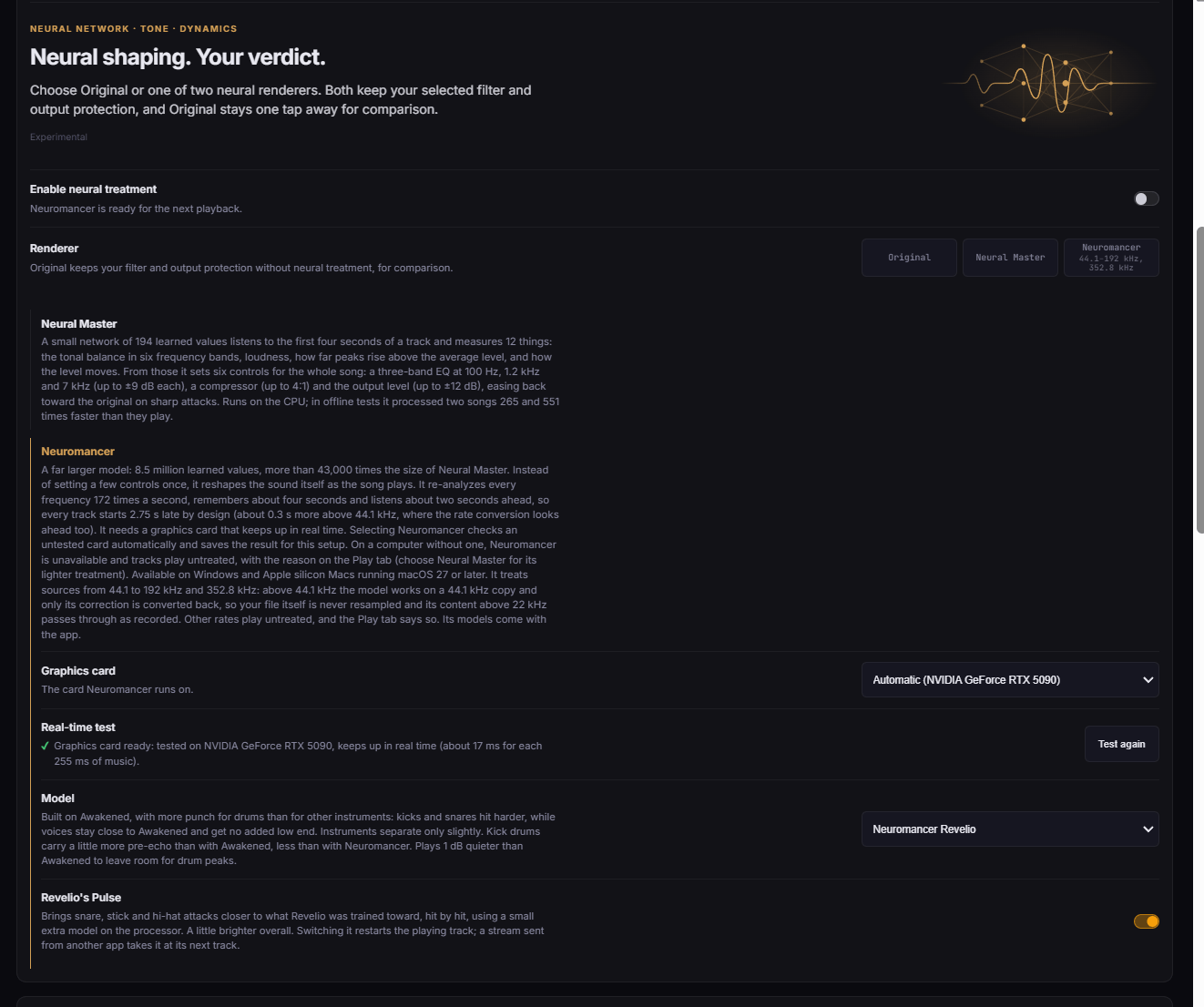
Neuromancer is not a filter. It runs on your graphics card (or on the Neural Engine of an iPhone or iPad) and gently reworks the music as it plays, before the upsampling filters do their job. Think of it as a light remastering pass, done live: it looks at your music 172 times a second, while listening about two seconds ahead.
There are three flavours:
- Neuromancer: a little more punch in the bass, and a slightly warmer balance.
- Neuromancer Awakened: the start of every note comes forward: snares, guitar picks, consonants.
- Neuromancer Revelio: the most instrument-aware of the three. It learned from a studio treatment that first split each song into its separate instruments and shaped each one on its own, and it learned to do that from the finished mix alone, something a normal audio processor can’t do. The drums hit harder while voices stay natural, and to my ears the instruments separate more clearly. Switch on its Pulse option and a second, smaller AI detects each drum and cymbal hit as it comes and decides how much to sharpen it.
How big is the change? Small, on purpose: the kick, the bass note and the snare come forward by a fraction of a decibel to about two, and little else moves. It is not an EQ. Switch back to Original and you will hear exactly what it does.
And now the combination I keep coming back to: Revelio with Pulse switched on, feeding Organik Pulse. It is really fun and energetic, and it still sounds natural.
The first time I heard Neuromancer, I listened for more than half an hour and fell in love with it. That first model is now frozen: it will never change. Anything I train later arrives as a new choice in the menu, never as a replacement for the one you already like.
Each model also comes in a lighter Eco version that needs up to three times less processing, for slower graphics cards and for phones. And with hi-res files, Neuromancer never converts your music down: it works out its change at CD quality and adds only that change to your original recording.
I have not found another music player that does anything like this, live.
Beside it sits Neural Master, a tiny AI that runs on the processor. It listens to the first four seconds of a song and sets a gentle EQ and compressor for the rest of it. No graphics card needed.
Good to know: Neuromancer is experimental. Music starts about three seconds later. On a PC it needs a dedicated graphics card (an NVIDIA RTX 3060 or AMD RX 6600 or better), and HeadMania tests your card and tells you whether it keeps up. On iPhone and iPad it needs iOS 27. It plays 3 dB quieter (4 dB with Revelio) so loud drums keep their punch, so turn the volume up a little when you compare. And it is free on every platform; it always will be.
4. Room Correction: Your Phone Measures, HeadMania Corrects
Here is a truth : your room changes the bass more than any filter ever will. Some notes boom, others disappear, depending on where you sit.
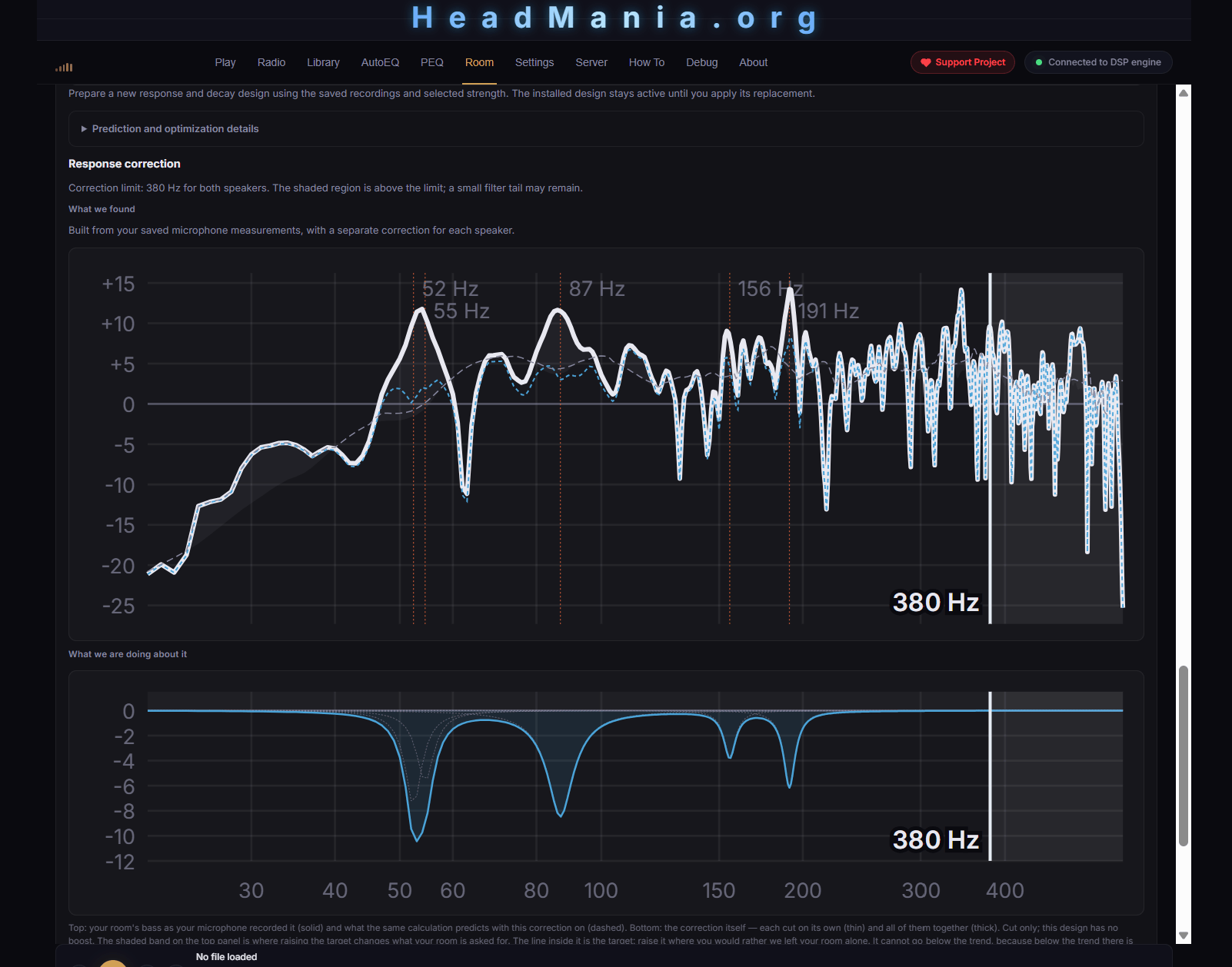
HeadMania can now cut those booms. Put your iPhone at your listening seat. The phone tells your UPnP network player to play the test sweeps by itself (you don’t touch a thing) and records them with its own microphone, or with a USB-C measurement microphone if you have one. HeadMania then finds the bass notes your room exaggerates and cuts each one by the amount it measured, separately for each speaker. It can even shorten notes that keep ringing in the room (that part is still experimental).
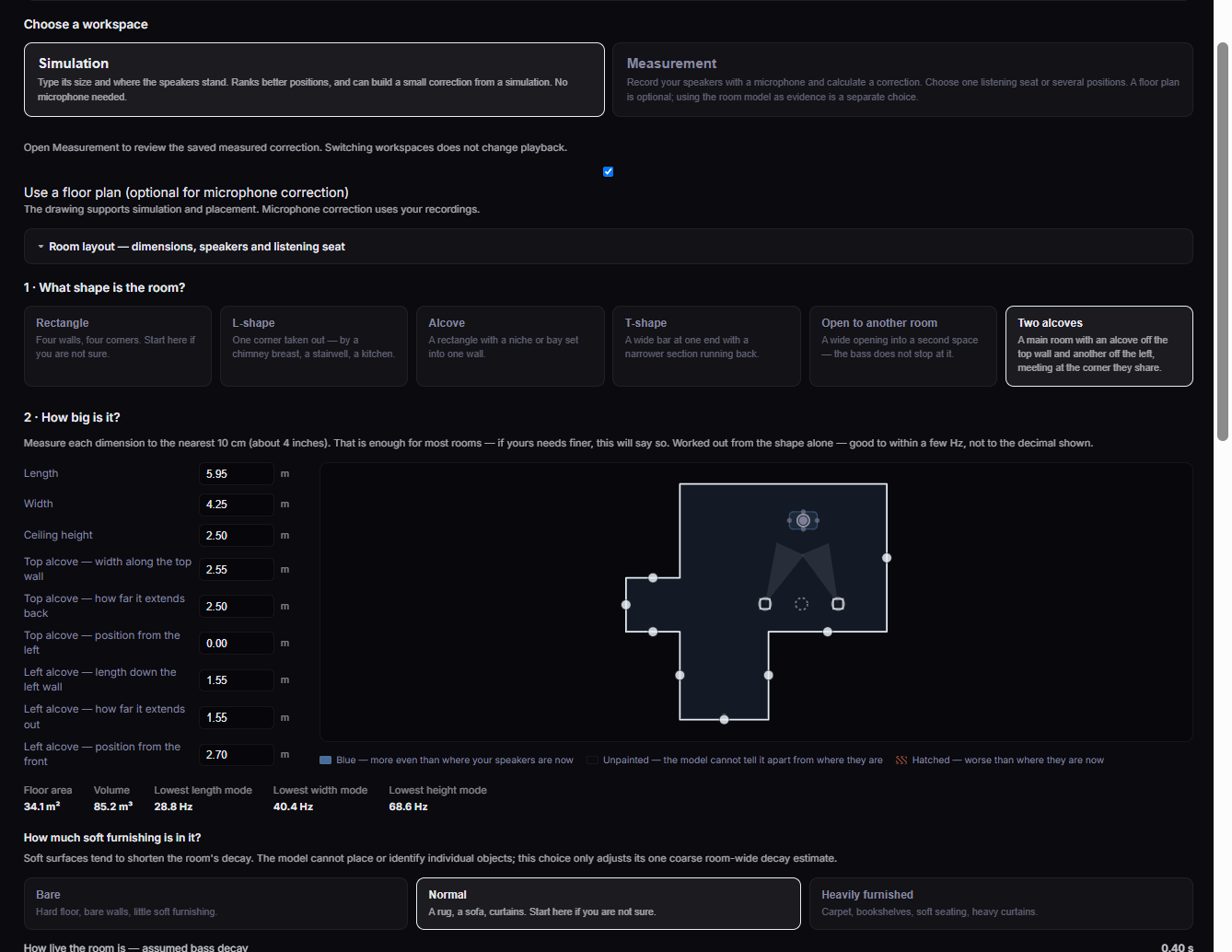
You see the result on a graph, you can adjust it with your finger, and a Fullness control keeps more of the bass you like. No microphone? You can draw your room instead, and a 3D simulation of how sound waves move inside it predicts the bass and helps you find better spots for your speakers and your chair.
The first time I used it at home, on the system around the Rockna, my room needed four cuts, the deepest almost 8 dB at 37 Hz, measured with nothing more than the iPhone. I applied it on the phone, then in the Windows app. My note from that evening: it doesn’t take away too much, and it sounds awesome.
Good to know: it corrects the bass, for one seat; no correction can fix echoes off the walls. It is still in testing, and the app says so. It works on PCM output at ×8 and above, not on DSD. On iPhone and iPad, measuring is free, and hearing the correction is part of the Signature Edition.


5. The Efficient Engine: Same Sound, a Fraction of the Work
The biggest filters are hungry. So for the latest release, 3.2.2, I rebuilt the maths underneath them. Same filters, same sound, smarter arithmetic.
The numbers are easy to read. On one core of a Ryzen 9 9950X3D, Organik at 4 million taps used to run at 2.5× real time. Now it runs at 21×. In everyday terms, one processor core now filters a four-minute song in about 11 seconds, instead of more than a minute and a half. On an M5 Max MacBook, the old engine’s slowest moments took longer than the music they carried, which means it could stumble. With the Efficient engine, those same moments take about a sixth of that time.
The difference from the old engine sits nearly 300 dB below the music, far beyond anything a DAC can reproduce. And if you ever want the old engine back, one switch restores it, bit for bit.
Good to know: it is on by default on Windows and on Apple Silicon Macs. A few setups still use the classic engine for now, and the app tells you which engine is running and why. On iPhone and iPad it is in testing.
6. DSD, Made In-House, and Higher Rates
In May, HeadMania sent your DAC PCM. Now it can also build DSD itself, the one-bit format many DACs love, from DSD64 all the way to DSD1024 (and DSD2048, experimental, for converters that take it). It can send it straight to a USB DAC, as DoP, or across the network to a streamer. If your DAC cannot take what you asked for, HeadMania steps down gracefully and shows you exactly what is playing.
For tinkerers there is an optional advanced modulator, called “EC”, that measures far quieter on the bench. That extra quietness sits well below what any DAC can reproduce, so think of it as extra safety margin rather than a night-and-day change.
DSD and PCM now also play at the same loudness, so when you compare them, you compare the sound, not the volume.
For PCM, the ceiling went up too: ×16 (705.6/768 kHz) and ×32 (up to 1.536 MHz). In the audible range these are identical to ×8. The benefit is that your DAC’s own output filter gets an easier job. Whether you hear that depends on your DAC.
Good to know: the EC modulator needs more processing. DSD1024 and DSD2048 are experimental (dsd1024 was confirmed to be working by a few users). iPhone and iPad go up to ×16, and send DSD only to network players.
7. For the Precision-Obsessed: Mixed Phase and Reference
Mixed Phase is a new family that sits between linear phase and Organik. It is a different character, not a “better” one, and well worth a listen.
Reference filters go up to 16 million taps, calculated with about twice the numerical precision of a normal 64-bit audio engine. I’ll be honest with you: nobody can hear those extra decimal places. I built them so I would know there is nothing left on the table.
Good to know: Reference filters run on files and the network server only, not on live capture, on a strong desktop with up to 10 GB of free memory.
8. Lossless Internet Radio
Files and live capture now have a third companion: a Radio tab with 22 stations. Every one is lossless FLAC over a secure connection, and the app will not accept anything less, by design. A station goes through exactly the same chain as a file: every filter, Neuromancer, DSD, the relay to your network player.
Good to know: it is a curated list and you cannot add your own stations yet. Changing the filter restarts the station. On iPhone and iPad you get the 14 stations whose owners gave written permission.
9. HeadMania in Your Pocket: iPhone and iPad
A million-tap audio processor in your pocket. The iPhone and iPad app runs the same 64-bit engine as the desktop and feeds a USB DAC (a simple USB-C-to-3.5 mm dongle counts) or a network DAC on your Wi-Fi, at up to 768 kHz.
It plays 1 million taps live on an iPhone and 4 million on an M-series iPad. I could not find another app that runs filters this big live on a phone or a tablet. Organik Pulse at a million taps is how my own iPhone plays music now.
[Upload video: D:\Headmania\HeadMania Upsampler Productions\App Intro\Mobile Intro.mp4]
Feed it your own files, the lossless radio, or send music to it from any UPnP app such as mConnect, JPLAY or Audirvana. Neuromancer runs on the phone’s own Neural Engine, and the room measurements start right here, with the phone’s microphone.
The free version is complete and permanent: every filter below 500,000 taps, Neuromancer, all the inputs, and measuring your room. One optional purchase, the Signature Edition, adds the biggest filters and hearing your room correction. One payment, no subscription, and a 30-day free trial first.
Good to know: it does not play through the phone’s speaker, Bluetooth or AirPods; it needs a real DAC. Neuromancer needs iOS 27 and uses more battery.
10. The Mac, the Network, and Your Headphones
The Mac app, grown up. In May the Mac version had only just arrived. Today it is a full native app for Apple Silicon, with the same engine and filters as Windows. On both, it can capture the sound of any app without installing an extra driver. As far as I can find, no other player does that on both desktops and sends it through a million-tap-class upsampler on to your DAC or network player.
A calmer network. Diretta works, big streams get a 12-second safety buffer for Wi-Fi hiccups, and if your network cannot keep up with the rate you picked, the app tells you plainly instead of dropping audio. It never lowers your quality behind your back.
Your headphones, measured. AutoEQ now covers 8,850 headphones, and a 10-band parametric EQ takes the settings you paste from your favourite measurement site.


Everyday comforts. Files start playing sooner, folders inside folders are found, you can switch filters while the music plays, and the Play screen shows album art and the real signal chain, from source to filter to DAC.
11. An App That Tells You the Truth
The biggest change since May is not a filter. It is an attitude. The About page shows real measurements for the filters, not marketing words. The Play screen shows the filter and the rate actually running, not just what you asked for. The waveform marks in red the peaks that would clip. And the “Listener favourite” tag is gone, because no listening test backed it. When I make a claim, I want you to be able to check it.
So, Is It Really One of the Best in the World?
I know how that sounds. So here is why I am comfortable saying it. HeadMania gives you:
- filters of up to 4 million taps live on a PC or Mac, 1 million on a phone,4 million on ipad pro(m5) and 16 million in Reference precision;
- filters that react to each drum hit, live, which, as far as I can find, no other software player does;
- an AI that remasters your music as it plays; it
- its own DSD, up to DSD1024/2048 ; 2048 is experimental
- room correction that your phone measures and the app applies;
- and real measurements you can check, right inside the app.
Others offer some of these. I do not know of anything else, free or paid, that offers all of them. But don’t take my word for it. Put on music you love, choose Organik Pulse, switch on Revelio with Pulse, and listen.
System Requirements
The biggest filters still need serious hardware, but the Efficient engine moved the line a long way.
- Windows: 64-bit Windows 11 and a processor with AVX2, which covers Intel Core processors from 2013 on and any AMD Ryzen. Lighter filters run on an ordinary computer; the biggest ones at the highest rates want a recent multi-core desktop. 16 GB of memory recommended.
- Neuromancer on a PC: a dedicated graphics card, NVIDIA RTX 3060 or AMD RX 6600 or better. Everything else runs without one.
- Mac: Apple Silicon.
- iPhone and iPad: iOS 15 or later and a USB or network DAC. Neuromancer needs iOS 27; 4 million taps need an M-series iPad. (Neuromancer has been validated on iphone 18 pro max and Ipad 11 Pro M5
- Capturing the sound of other apps: the setup from the first article still applies: your computer’s default output must be a different device from the one HeadMania plays to (a free virtual cable works if you only have one), and the app you capture from must not use exclusive mode. The How To tab in the app walks you through it.
Back to the Music
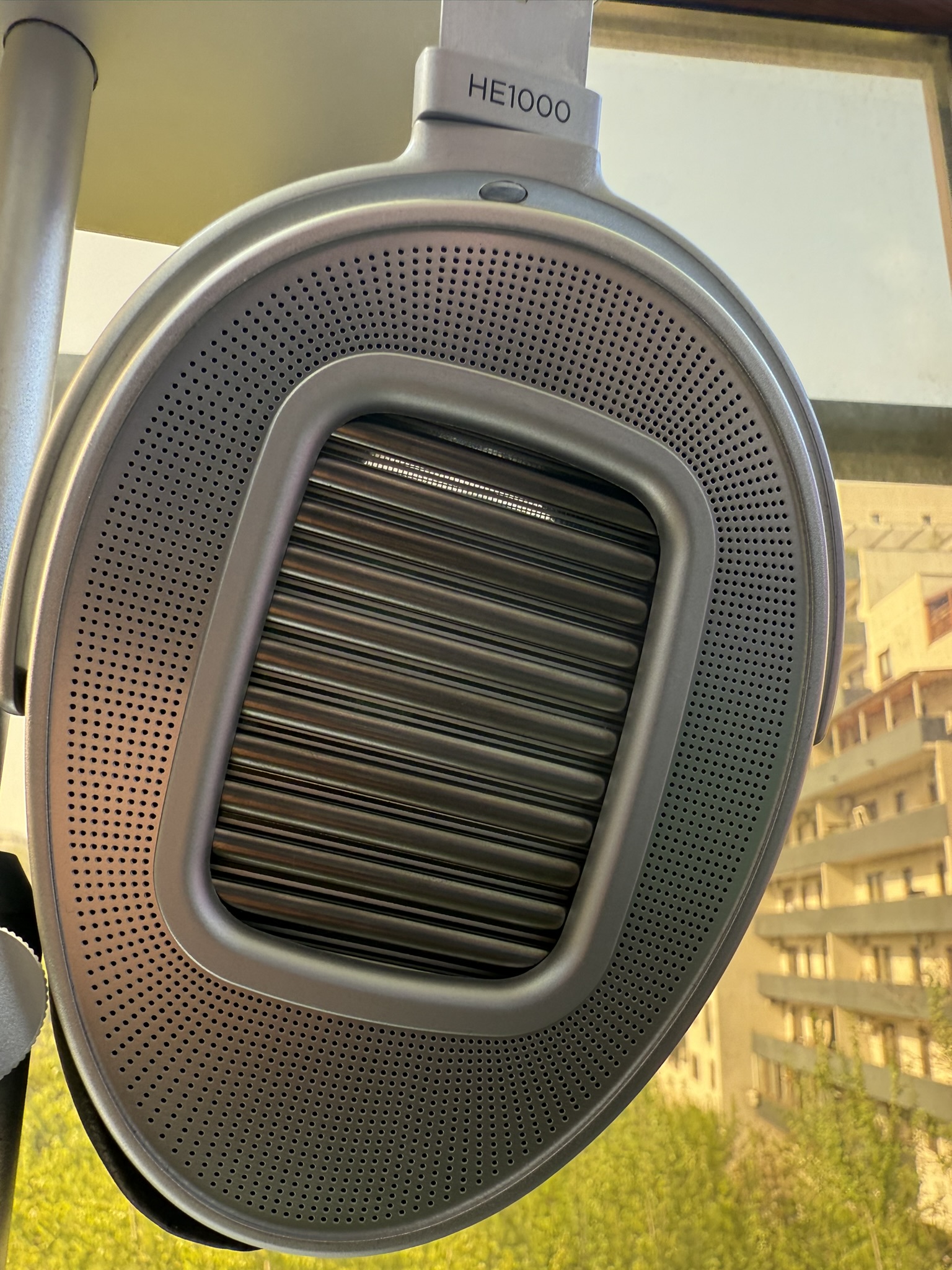
In May I told you I could not stop listening across all my systems: the headphones and the Martin Logans on the Rockna Wavedream, the Piega Coax 611 speakers on the Linn Selekt Organik. That is still true, only more so. Now there is an iPhone in my pocket running Organik Pulse at a million taps, a room whose worst bass booms are finally cut, and Revelio with Pulse feeding Organik Pulse whenever I want music that is fun, energetic and still natural.
Queue up your favourite song and just listen. Last time I said it hits hard, it goes deep, and it might just wipe the floor with you. It still does. Now it also hears every drum hit, and knows what your room was doing to the bass.
A Note on “Free”, Again
HeadMania is still a one-man passion project, built in my spare time, and on Windows and Mac it is still free. Please, once again, do not mistake “free” for “amateur.” Everything in this article is engineered, measured and listened to with the same care I would expect from the most expensive gear in my racks. And my offer from May still stands: if you insist that free cannot compete with your system, I can always start charging you a percentage of its worth.
It is tested on my own systems and by a growing group of listeners, but you may still find a quirk on yours. When you do, tell me: several of the fixes behind this article started as one listener’s report.
If you want to support the work, Patreon is the place. It keeps the nights long and the releases coming.
- Download for Windows and Mac: https://github.com/danghe/HeadManiaReleases/releases
- iPhone and iPad (App Store): https://apps.apple.com/ro/app/headmania-org-upsampler/id6786069896
- Support on Patreon: https://www.patreon.com/c/HeadMania
- Telegram group, for help, feedback and listening notes: https://t.me/+lIFYDf6ZmMk4N2E0
- Bugs and feature requests: https://github.com/danghe/HeadManiaReleases/issues
A short how-to video for capturing the sound of other apps (still current): (updated video will come up soon)



Leave a Reply